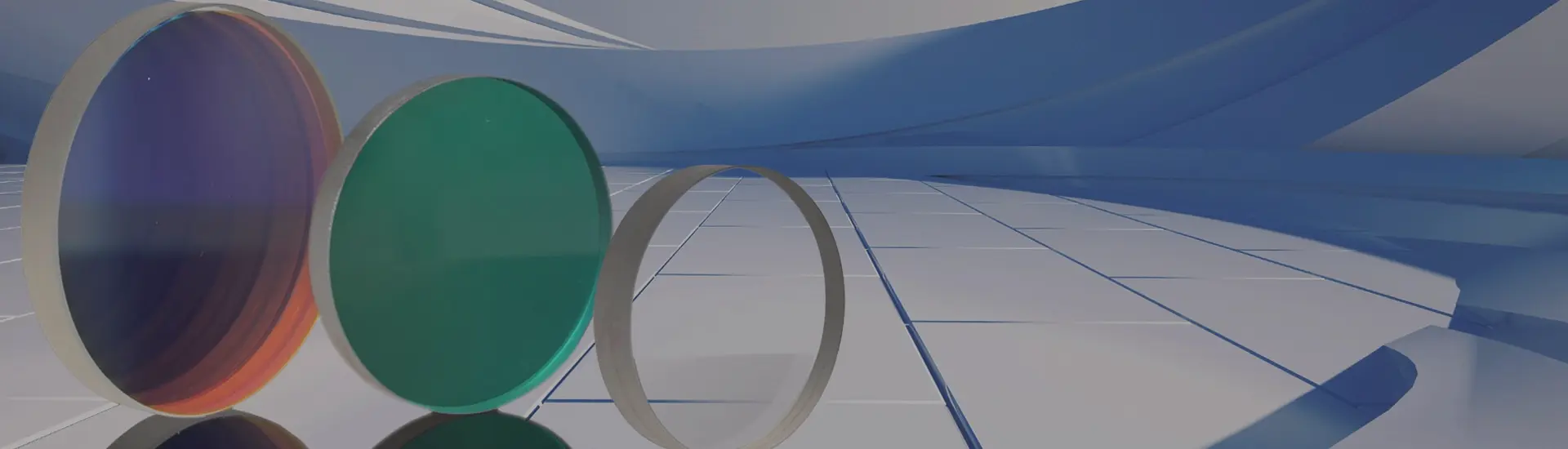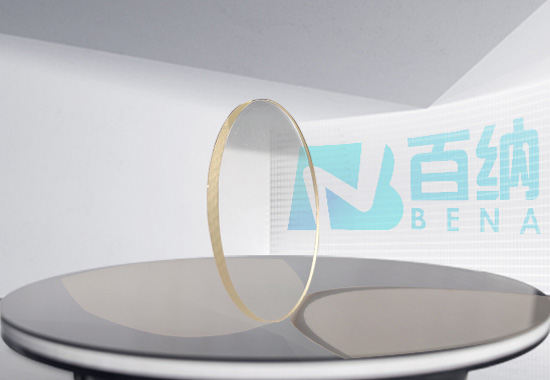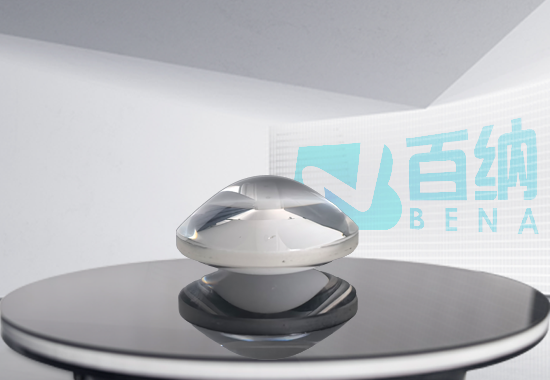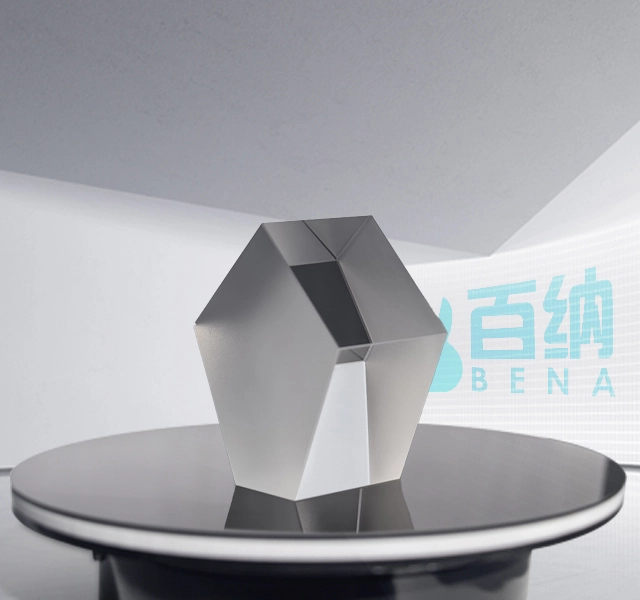
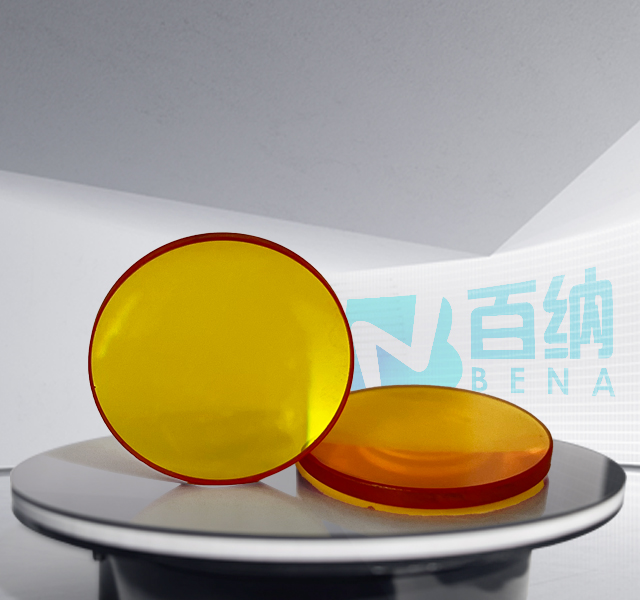
The ZnSe lens is made from laser-grade CVD (Chemical Vapor Deposition) zinc selenide and features anti-reflective coatings on both surfaces to reduce optical loss.
For optimal focusing performance, a plano-convex ZnSe lens should be installed with its convex side facing the incoming laser beam and the flat side facing the workpiece, ensuring efficient energy delivery in laser processing.
ZnSe lenses are widely used in CO₂ laser systems and infrared optical applications due to their high transmission in the mid-infrared range. They are also applied in biomedical and defense-related optical systems.
In addition, ZnSe lenses can be used for beam alignment and calibration in optical setups because of their stable transmission characteristics.
High Transmittance:
ZnSe exhibits high transmittance in both visible and infrared wavelengths, with a broad transmission range covering wavelengths from 0.5μm to 22μm, making it suitable for a wide range of ZnSe lenses.
Low Absorption Coefficient:
ZnSe material has a low absorption coefficient and minimal optical transmission loss, making it suitable for high-power laser systems, making it suitable for high-power laser systems and ZnSe laser lens applications.
High Thermal Resistance:
ZnSe has a high thermal expansion coefficient, allowing it to maintain stability in high-temperature environments.
Uniform Refractive Index:
ZnSe offers excellent uniformity and consistency in its refractive index, making it ideal for applications requiring high-precision optical components.
Specifications of ZnSe lens
| Specifications | Commercial spec. | High precision spec. |
| Dimension | 5mm~350mm | |
| Dimension tolerance | ±0.1mm | ±0.05mm |
| Focal length tolerance | ±2% | ±1% |
| Surface quality | 60/40 | 40/20 |
| Centration | < 3 arc min | <1arc min |
| Surface figure | 3λ | 2λ |
| Surface irregularity | 1/4λ | 1/10λ |
| Clear aperture | >85% of dim | >90% of dim |
| Bevel | <0.2mm x 45deg | <0.1mm x 45deg |
| Coating | AR/AR 7-12um / 10.6um / 2-13um | |
| Diameter (mm) | Focal length (mm) | Edge thickness (mm) |
| 12.7 | 25.4 | 1.52 |
| 19.05 | 25.4 | 2.16 |
| 25.4 | 63.5 | 2.16 |
| 25.4 | 127 | 2.59 |
| 25.4 | 254 | 2.82 |
| 27.94 | 63.5 | 2.16 |
| 27.94 | 127 | 4.06 |
| 27.94 | 190.5 | 2.69 |
| 27.94 | 254 | 2.77 |
| 38.1 | 63.5 | 2.03 |
| 38.1 | 63.5 | 2.62 |
| 38.1 | 88.9 | 8.99 |
| 38.1 | 95.25 | 2.18 |
| 38.1 | 127 | 7.11 |
| 38.1 | 127 | 7.62 |
| 38.1 | 190.5 | 7.11 |
| 38.1 | 190.5 | 7.62 |
| 50.8 | 190.5 | 7.62 |
| 50.8 | 190.5 | 7.87 |
| 50.8 | 190.5 | 9.65 |
| 63.5 | 254 | 9.9 |
High-Power CO2 Laser Systems:
Used as substrate material for mirrors and beam splitters in high-power laser systems.
Thermal Imaging Systems:
Employed as protective windows and optical elements in forward-looking infrared (FLIR) thermal imaging systems using ZnSe lenses, while silicon lenses are also commonly used in infrared systems operating in different wavelength ranges.
Medical Field:
Utilized in biomedical applications, such as beam calibration and thermal radiation measurement instruments.
Industrial Applications:
Serves as windows and lenses in infrared spectrometers and thermal radiation measurement instruments, where ZnSe focus lens components are used for accurate beam focusing.